

A Practical Revenue and Cost‑management Guide
Running a newspaper or magazine in 2026 is not for the faint of heart. Even publishers who abandoned print years ago quickly discovered that digital‑only publishing still carries significant costs: editorial salaries, sales teams, production workflows, accounting, IT infrastructure, hosting, cybersecurity, and marketing. The economics have changed, but the financial pressure hasn’t.
Yet small, nimble publishers can build sustainable local news operations if they understand where modern revenue comes from, how to structure costs, and how to avoid the traps that killed so many legacy outlets.
This article breaks down the real economics of publishing today and offers a roadmap for small startups trying to build a viable local newspaper or magazine.
1. Understanding the Modern Cost Structure
Even without print, a local news operation has unavoidable fixed and variable costs. Below is a realistic breakdown for a lean, professional small newsroom (5–10 people).
Typical Annual Cost Ranges (2026)
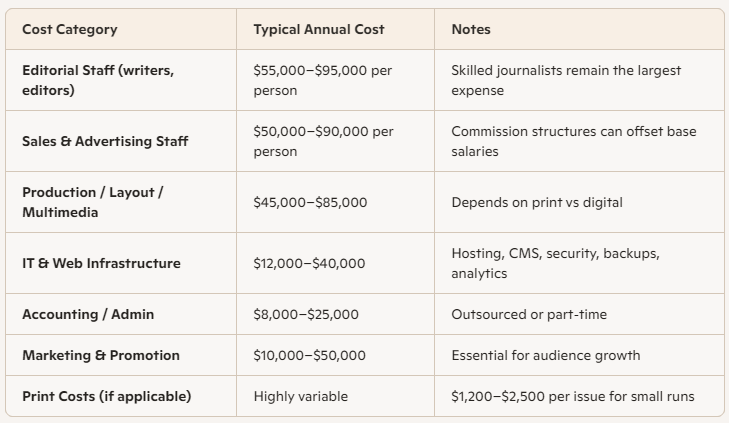
Cost Ratios for a Healthy Operation
A sustainable small publisher typically follows these ratios:
45–55% → Editorial
20–30% → Sales & Marketing
10–15% → Technology & Infrastructure
5–10% → Admin & Accounting
Optional: 20–40% → Print (if still producing physical editions)
If print exceeds 40% of total costs, it becomes a threat to survival unless offset by strong advertising.
2. Where Revenue Comes From in 2026
The old model print ads + classifieds is gone. Modern publishers need multiple revenue streams, each contributing a slice of the pie.
Below is a realistic revenue mix for a small local publisher:
Modern Revenue Mix (2026)
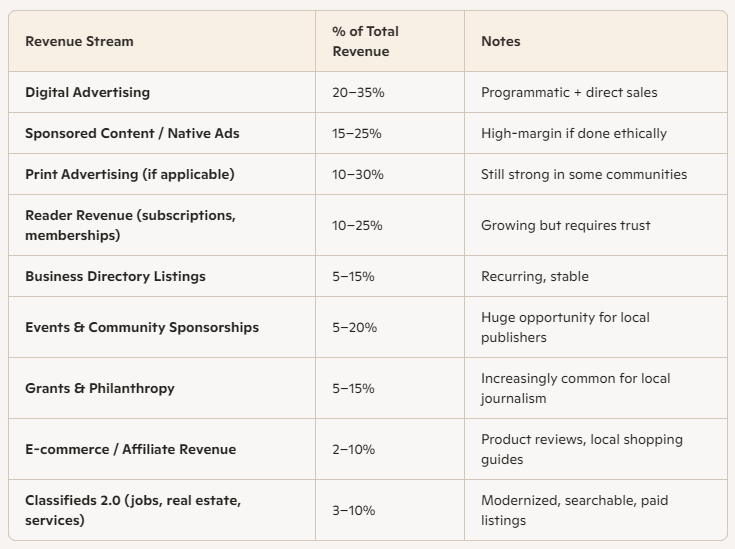
A resilient publisher uses 6–10 revenue streams, not one or two.
3. The Most Promising Revenue Opportunities for 2026
A. Local Business Advertising 2.0
Local businesses still want exposure but they expect more than banner ads.
Offer:
Sponsored articles
Social media amplification
Video interviews
Business spotlight features
Newsletter sponsorships
Seasonal advertising packages
A small publisher can generate $1,500–$5,000 per advertiser per year with bundled offerings.
B. Memberships Instead of Paywalls
Paywalls often fail for small markets. Memberships succeed because they feel like supporting local journalism, not buying content.
Offer perks:
Early access to stories
Member-only newsletters
Invitations to events
Recognition on a “supporters” page
A healthy membership program can bring $5–$15 per reader per month.
C. Community Events & Local Experiences
Events are now one of the top revenue sources for local publishers.
Examples:
Local business expos
Food festivals
Home & garden shows
“Best of the City” awards nights
Workshops (photography, writing, cooking)
Events can generate $10,000–$100,000 annually, even for small publishers.
D. Sponsored Newsletters
Email is the new front page.
Local newsletters often achieve:
40–60% open rates
High advertiser demand
Premium sponsorship pricing
A single sponsor can pay $300–$1,200 per issue depending on audience size.
E. Business Directories & Marketplace Listings
Think of it as a modern Yellow Pages.
Offer:
Featured listings
Verified business badges
SEO‑optimized profile pages
Local deals and coupons
This can become a recurring monthly revenue engine.
F. Grants & Nonprofit Partnerships
In 2026, journalism grants are more abundant than ever.
Sources include:
Local foundations
Journalism innovation funds
Government programs
University partnerships
Small publishers often secure $10,000–$100,000 per year in grants.
4. How a Small Startup Can Actually Survive
Here’s the blueprint that works for most successful small publishers:
Step 1: Start Digital-First, Not Digital-Only
Digital-first keeps costs low.
Print can be added later as:
A monthly digest
A quarterly magazine
A special edition (e.g., “Best of the City”)
This avoids the crushing weekly print bill.
Step 2: Keep the Core Team Lean
A typical startup team:
1 editor-in-chief / writer
1–2 freelance writers
1 ad sales rep
1 part-time designer
1 technical contractor
Everything else is outsourced.
Step 3: Use Affordable Technology
Avoid enterprise CMS platforms.
Use:
WordPress + premium plugins
Ghost for newsletters
Canva or Affinity for design
Cloud hosting with CDN
AI-assisted workflows for production
This keeps tech costs under $500–$1,000 per month.
Step 4: Build Revenue Before Scaling Content
The biggest mistake new publishers make is producing too much content before building revenue.
Instead:
Launch with 3–5 strong weekly stories
Build a newsletter audience
Sell sponsorships early
Add more content as revenue grows
Step 5: Become the Local Authority
Small publishers win by owning:
Local politics
Local business news
Community events
Crime & safety
Real estate trends
School board coverage
Large media ignores these topics but communities crave them.
5. The Sustainable Local Publishing Model (2026)
A realistic, sustainable model for a small local publisher looks like this:
Annual Revenue Target:
$250,000–$600,000
Annual Operating Costs:
$180,000–$450,000
Profit Margin:
10–25% (healthy for media)
Key Characteristics of Successful Publishers
Multiple revenue streams
Strong community identity
High newsletter engagement
Local business partnerships
Lean operations
Smart use of automation and AI
Occasional print, not constant print
Final Thoughts
Local journalism is expensive — but not impossible.
The publishers who survive in 2026 are the ones who:
Diversify revenue
Keep costs lean
Build community trust
Use technology intelligently
Focus on local stories big media ignores
A small startup can run a viable newspaper or magazine today.
It just requires a modern business model, not the legacy one that collapsed.
If you want, I can also create:
A full business plan
A cost calculator
A revenue forecast
A pitch deck for investors
A staffing plan for a 1–10 person newsroom
Frinding the Revenue:
We can categorize publishers based on the type of content they produce and the platforms they use to distribute it. Here’s a quick breakdown by these attributes:
subscriptions
display
advertorials
manufacturer/distributor
events
ecommerce
related businesses
donations
micropayment (one-time fees)
paywall
Subscription and membership models involve readers paying regularly for premium content. This method is popular among digital publishers because it offers a reliable income.
Display advertising uses ads, banners, videos, and other visuals on websites. While display ads are a primary source for print and digital advertising. Display Classifieds provide a lower fee option for advertisers to opt-in to.
Advertorial advertising fits into editorial content, giving readers a smoother ad experience. Publishers use it to partner with brands while keeping their audience engaged.
Manufacturer brand funding encourages retailers to advertise by having the manufacturer or distributor pay either all or part of the ad based on volume sales.
Events are an important revenue stream. Publishers host conferences, webinars, or live gatherings. They generate income while building stronger audience connections and enhancing brand visibility.
E-commerce lets publishers earn money by selling branded merchandise or using affiliate marketing. This approach works especially well for niche publishers with loyal audiences.
Publishers are expanding into areas like training programs, consulting services, content licensing and providing graphic, video production, creative, writing services. These ventures add to their revenue streams and lessen reliance on ads or subscriptions.
Donations. Many publishers ask their audience for financial support through donations. This approach works best for organizations with strong reader trust and loyalty.
Philanthropic funding supports publishers by providing grants for investigative journalism or community-oriented projects. This model is essential for nonprofit news organizations and small publishers.
Micropayment systems let readers pay small, one-time fees for specific articles or features. This model offers an alternative to subscriptions, appealing to occasional readers seeking selective access.
Paywall and subscription management tools enable publishers to monetize their content by implementing flexible access models, such as pay-per-article or subscription plans. These platforms help track user engagement, manage payments, and optimize revenue strategies.
What a user journey in a publisher’s ecosystem might look like:
User lands on a page (CMS): A user arrives on a page generated by the CMS. They interact with content such as articles, videos, or embedded ads.
Content engagement and ad delivery (Ads): Based on the user’s profile, the ad management system displays targeted ads. It leverages data from the CDP or DMP if available, to show relevant content.
Subscription or registration: The user may be prompted to subscribe for paywalled content. When they register or subscribe, their information is sent to the CDP. A detailed profile is created for personalized engagement.
Data collection (CDP): The CDP collects and stores data from various interactions (page views, content preferences, ad engagement, etc.). It builds a unified profile of the user across sessions.
Audience segmentation (DMP): For anonymous visitors who do not register or subscribe, the DMP segments them based on anonymous data (e.g., behavior, interests). This is used for ad targeting without creating a personal profile.
Behavioral insights (Analytics and Reporting): All interactions are tracked by the analytics system. It provides insights into content performance, user engagement, and traffic. These insights inform editorial and marketing strategies.
Engagement and personalization (Email and Video):
Email: If the user opts into newsletters, the email marketing system can send targeted newsletters. It’s personalized using data from the CDP.
Video Management: For users engaging with video content, data flows to the CDP. It is enriching their profile with video preferences to personalize their content experience.
Publishers News
Email: news@publishersnews.net
Web: publishersnews.net
Tel: 1-800-971-5030
Publishers News, Computer News, Google News, Ad Ideas, Editorial, Co-op Advertising, Etcetera and ToolBox
Private Browsers: DuckDuckGo, Qwant Or SearX
Private Operating Systems: Linux or Tails
Private Cloud Servers: Skiff, Mega, pCloud, Proton, Sync, Tresorit
Alternative to YouTube: Rumble, Odysee, Dailymotion