

Create Revenue in 2026
Small and medium‑sized newspapers across North America enter 2026 facing a paradox: audience demand for trustworthy local information remains strong, yet traditional revenue streams continue to erode.
The most successful outlets are those that have embraced diversified revenue, cross‑platform advertising, community‑rooted engagement, and pragmatic use of technology. Industry surveys show that subscription growth has plateaued and AI‑driven search is reshaping traffic patterns, forcing publishers to rethink sustainability models.
Fran Wills, CEO of the Local Media Consortium, notes that “subscription growth has plateaued, and AI‑driven search is reshaping traffic patterns,” pushing publishers toward innovative cross‑platform ad strategies and deeper audience engagement programs.
At the same time, digital ad revenue remains one of the few bright spots: 72% of publishers saw digital revenue up or flat in 2025, and 85% expect similar growth in 2026. This environment demands that small and mid‑sized newspapers adopt a more entrepreneurial mindset, one that blends journalism, product thinking, and community partnership.
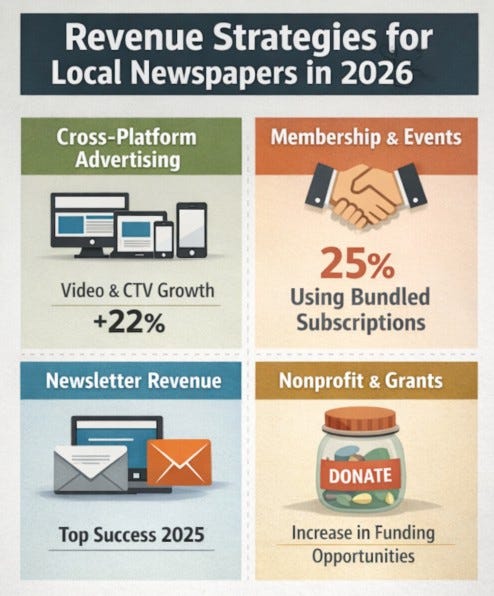
A major shift underway is the rise of cross‑platform advertising, which is expected to dominate local media strategies in 2026. Publishers are increasingly packaging campaigns across web, mobile, newsletters, video, and even OTT/CTV channels. Growth in video and branded content has been especially strong, with publishers citing video/OTT/CTV and email newsletters as top revenue successes in 2025.
This aligns with broader market data showing that video ads on newspaper sites grew 22% globally in 2022, reaching $1 billion.
For small outlets, this means investing in lightweight video production, partnering with local videographers, or using templated video tools to create sponsor‑friendly content. Derek Price of Green Shoot Media argues that the real story in 2026 will be “pragmatism”, publishers doubling down on revenue streams that actually work, such as digital subscriptions, branded content, and outsourced special sections.
His advice to ad managers: use data to pinpoint high‑performing topics and design products around them, rather than scattering efforts across too many initiatives.

Still, relying on advertising alone is risky. Local journalism experts emphasize diversified revenue models as the most realistic path to sustainability. A 2026 playbook for local journalism highlights memberships, tiered subscriptions, nonprofit funding, events, and public grants as essential components of a modern revenue mix.
Memberships, especially those offering local perks or behind‑the‑scenes access have proven effective in boosting retention. Bundled subscriptions (news + video) have also been adopted by 25% of newspapers, increasing retention by 15%. Loyalty programs can further increase retention by 25%, suggesting that newspapers should think like consumer focused digital businesses rather than legacy media.
Events remain an underutilized but powerful revenue stream: community forums, local business expos, and sponsored speaker series not only generate income but also strengthen the paper’s role as a civic institution.
Another promising avenue is audience centric product development. Hyperlocal newsletters focused on neighborhoods, schools, or specific interest groups have become one of the most effective tools for engagement and monetization. The Local Media Consortium survey found newsletters among the top successes of 2025.
Small newsrooms can start with a single high‑quality newsletter that readers forward to friends, building organic growth. Data‑driven local tools such as school rating dashboards or permit trackers also create daily utility, increasing the likelihood that readers will pay.
These product focused approaches align with broader industry trends: digital display ads grew 8% to $3.2 billion in the U.S. in 2022, and programmatic ads now account for 40% of digital newspaper ad spend. Newspapers that build strong digital products are better positioned to capture these revenue streams.
Legal structure is another area where innovation is accelerating. Many small and mid‑sized outlets are exploring nonprofit or hybrid models, which unlock philanthropic funding and grant opportunities. This approach has gained traction as advertising declines and communities seek to preserve local reporting.
The 2026 local journalism strategy guide notes that nonprofit and hybrid structures allow outlets to blend philanthropy with traditional revenue, creating more stable financial footing. Collaborative reporting networks where multiple outlets share reporters, data, or investigative resources also reduce costs and attract funders interested in regional impact.
These collaborations are especially valuable in rural or underserved areas where single outlets cannot sustain full beats on their own.

Technology, particularly AI, is reshaping workflows and revenue opportunities. According to an Associated Press survey, 73.8% of newsroom professionals had used generative AI in some capacity by 2024. In 2026, more local newsrooms will experiment with AI tools to boost efficiency, though some will face “embarrassing scandals” when misused, as Derek Price warns.
The most innovative publishers will use AI to free up staff time automating transcription, summarizing public documents, or generating templated content, while reinvesting saved hours into human‑centered storytelling. AI also enables new revenue products, such as personalized newsletters or automated real‑estate and business listings. However, newspapers must maintain transparency and editorial oversight to preserve trust.
The broader North American press market continues to transition from print to digital, driven by mobile consumption, multimedia demand, and advanced publishing technologies. Key factors influencing digital adoption include technological advancements, shifting consumer behavior, regulatory compliance, and increased competition from digital‑native outlets.
For small and mid‑sized newspapers, this means prioritizing mobile first design, investing in analytics, and ensuring compliance with privacy and advertising regulations. It also means embracing niche coverage areas where they can outperform national competitors local schools, zoning, courts, and community events.
Ultimately, the newspapers that thrive in 2026 will be those that embrace diversification, community connection, and strategic innovation.
They will treat journalism as both a civic mission and a product that must evolve with audience needs. They will build revenue portfolios that blend advertising, memberships, events, philanthropy, and digital products. They will use AI pragmatically, not as a replacement for journalists but as a tool to enhance efficiency.
And they will lean into collaboration across newsrooms, across platforms, and across their communities. The path forward is challenging, but the opportunities are real for publishers willing to rethink old assumptions and build models rooted in value, trust, and adaptability.